
RSS Designs In Fiber - My Handmade Designs on ARTFIRE
We take seriously the Forest Service's commitment to ecological restoration and will be challenging them to demonstrate that their salvage logging proposals are consistent with their commitment.
![]() |
| MY PHOTO OF MY COPY OF ROBERT GLENN KETCHUM'S BOOK ON THE TONGASS |
"As we flew over the monumental landscape in a tiny bush plane, the greenness of the world below commanded all out attention. Green of a richness unlike any shade of this color you have ever known. Green of more varieties and nuances than you can imagine. Green in every crack in every wall. Green covering the floors of the valley. Green
even in the milky waters flowing out of the glaciers. And everywhere that it is green, life abounds."
"Old-growth temperate rainforest once dominated the West Coast from Northern California to Kodiak Island in Alaska. Remnants of old growth, such as the Hohn Rain Forest on the Olympic Peninsula of Washington state, are scattered along the Pacific Coast. But, beautiful as they are, they are only remnants. The Tongass is a world
unto itself, and for centuries it has remained virtually undisturbed. Now a forest that has achieved full maturity, it has reached a steady state, encompassing trees of all ages, dominated by old monarchs of large size. Beneath their canopy, younger trees grow toward the light, ready to replace any of the giants that might succumb to wind, rot, insects, or disease. In the understory, herbs, shrubs, and vines grow in profusion. Old trees that die and fall open windows to the sky that are filled by the most vigorous younger trees. Lichens and moss grow everywhere on the forest floor as well as in the canopy. The decaying trunks of trees that have fallen become "nurse" logs, simultaneously decomposing into soil and serving as seedbeds for new growth. Biologists refer to this as a forest of uneven age, and consider it to be the most productive and diverse."
"When rainforests are logged, much of their stored carbon is released as a greenhouse gas pollutant during site preparation, manufacture, and transport of wood products, which in the case of the Tongass, involves long distances to the Pacific Rim. These losses are not made up by storing carbon temporarily in wood products or by planting trees, as the on-site reduction in carbon storage from logging takes at least 200 years to return to about the same amount of stored carbon in the uncut old-growth forest."
![]() |
| Cottontail Rabbit in A Bush |
![]() |
| Tree Tapestry Pillow |
![]() |
| Mountain Cabin Landscape in Filet Crochet |
![]() |
| Bear Head Silhouette in Filet Crochet |
![]() |
| Proud Rooster in Textured Filet Crochet |
![]() |
| Tree Tapestry Home Decor |
![]() |
| Celtic Woven Garden Suncatcher or Ornament |
"What keeps me up at night is actually 2 things, but connected. When are enough
of the people and governments on the planet going to realize and act on the fact
that we have to live our lives in such a way as to preserve the web of life the
best that we can — or are we going to keep negatively impacting our own habitat
to the point where it is not habitable by humans? Part of this — and a big part
of this for me — is I worry about how much of the forest that originally covered
the planet has been cut down and is still being cut down; we need to preserve
existing forests and plant trees that grow qucikly and strongly enough to grow
canopies/root structures in 15 to 25 years that keep the land cooler and
moister."
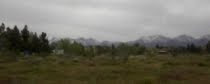
I took the above photo in April 2005 from a field just east of where I live in the east Antelope Valley. It is looking south from the Antelope Valley to the San Gabriel Mountains - which are now, in September 2009, hot and dry -- and burning.
Various sections of the San Gabriel Mountains in the Angeles National Forest were my stomping/hiking grounds for years and years. When I had time off -- and even sometimes when I had independent work and I took my work up there with me -- I spent hours of my life driving, picnicing and hiking through various forested areas: Big Tujunga, Switzer, Charlton Flat, Chilao, West Fork of the San Gabriel River, Mount Gleason up through Littlerock Dam area were some of my favorite places to go.
Unfortuantely, I am now sorrowing that so many of these places are in the Station Fire area.
I am really worried that Old Growth areas and Wilderness Areas are burning -- and not always at the low to moderate intensities.
I can only frevently hope that the canopies of the larger Old Growth is not burning.
For up-to-date information on what has been named the Station Fire (the fire burning across the Angeles National Forest), see the Incident Site Website by InciWeb.
Knowledge gives one a better ability to deal with something analytically, even if emotionally affected.
I've been going to US Forest Service meetings in California for 10-15 years now - for the Angeles National Forest and the Sierra Nevada National Forests. As part of studying papers and documents, I have learned about the climate of the California forests. They are different from most of the rest of the country -- they are classified as a Mediterranean Climate, which is discussed in fairly plain English here on Wikipedia. Mediterranean Climates developed ecologically and geologically in certain ways and their characteristics are discussed in a rather understandable language for the average person on Wikipedia.
Also, it was through the Sierra Nevada Forest Protection Campaign - and their Conservation Strategy, which I have a copy of, that I found out about the Globally Significant Biodiversity Hotspots that are identified by the International Conservation Scientists of Conservation International -- including the California Floristic Province, which the Angeles National Forest (where the Station Fire is burning) is part of.
The following quote off of the Wikipedia article on the Mediterranean Climate discusses that "....these communities are well suited to recover from droughts, floods, and fires....":
"The Mediterranean forests, woodlands, and scrub biome is closely associated with Mediterranean climate zones. Particularly distinctive of the climate are sclerophyll shrublands, called maquis in the Mediterranean Basin, chaparral in California, matorral in Chile, fynbos in South Africa, and mallee and kwongan shrublands in Australia. Aquatic communities in Mediterranean climate regions are adapted to a yearly cycle in which abiotic (environmental) controls of stream populations and community structure dominate during floods, biotic (e.g. competition and predation) controls become increasingly important as the discharge declines, and environmental controls regain dominance as environmental conditions become very harsh (i.e. hot and dry); as a result, these communities are well suited to recover from droughts, floods, and fires.[3]"
But I can't help but wonder - recover to what?
I can only fervently hope that the larger Old Growth is only getting fire scars on their trunks and that the fire is burning at a low enough intensity over most of the area so that natural recovery through heating of the seeds buried in the soil will bring a vibrant new growth to the area come next Spring!
Looking ahead is what we must do.
As an average citizen, I can't do too much about the fires actually burning, as I write this, in the Angeles National Forest. But I can look ahead and see what I can contribute to -- and I will be contributing to the TreePeople Mountain Forestry program for replanting areas that do not naturally heal.
Please take a look at the website of TreePeople and their Mountain Forestry programs - specifically their California Wildfire Restoration Initiative, where they have already posted about replanting the Angeles National Forest after the 2009 fires!!
From the California Wildfire Restoration Initiative of TreePeople:
"We advocate planting the most appropriate species prescribed by the Forest Service. Our aim is to plant the right tree in the right place with the right spacing apart. However, sometimes the best approach to restore burned areas is to stay out of the area and let it heal naturally."
I keep fervently hoping that the majestic, cathedral-like trees of Charlton Flat are still standing when it is all over.
A Huge Heartfelt Thanks to all the Firemen, US Forest Service staff and scientists -- and all the volunteers who are working so very hard to contain the Station Fire and save as much as we can of the Angeles National Forest and the communities around it!!!!!
--- And keep in mind, not all of the Station Fire area is actually burning -- and low intensity fire may be beneficial to the ecosystem -- and in some areas the fire has been low intensity.
We will still have a forest when it is all over, even if some of it needs restoration!!!
"NOW, THEREFORE, I, WILLIAM J. CLINTON, President of the United States
of America, by the authority vested in me by section 2 of the Act of
June 8, 1906 (34 Stat. 225, 16 U.S.C. 431), do proclaim that there are
hereby set apart and reserved as the Giant Sequoia National Monument,
for the purpose of protecting the objects identified in the above preceding
paragraphs, all lands and interests in lands owned or controlled by the
United States within the boundaries of the area described on the map
entitled ‘‘Proposed Giant Sequoia National Monument’’ attached to and forming
a part of this proclamation."
I have read in the Interpretations of the GSNM Presidential Proclamation about
the different views regarding the Scientific Advisory Board with the remanding
(invalidating) of the original Management Plan/Record of Decision from Art
Gaffrey.
As that (original) Management Plan was totally remanded and a
judge ordered them to re-write it, I agree with View 1 stated in Carrie Fox's
Interpretation of the Proclamation:
"View 1: Since the management plan associated with the last Scientific Advisory Board was invalidated, this will be the “initial management plan” and therefore another Scientific Advisory Board is required—one that is empanelled in the same time period in which the plan is being formulated and that will have the opportunity to comment on the draft plan. In apparent support of this, the Proclamation states that the Scientific Advisory Board is to provide scientific advice during the development of the initial management plan. [Lines 147-154]"
- from pages 12 and 13
of http://www.fs.fed.us/r5/sequoia/gsnm/carie_summary_interp_Proc.pdf
